How Canoe Landing Became CityPlace’s Backyard


How Canoe Landing Became CityPlace’s Backyard
When Canoe Landing Park opened in 2009, CityPlace was still being referred to as a “vertical suburb”: dense, disconnected, and unfinished. Fifteen years later, the park has become more than a green break between towers. It is a schoolyard, a playing field, a gathering space, and a visual landmark. In short, it serves as the neighborhood’s ground floor.
The Park That Built a Neighborhood
CityPlace came quickly. Built on former railway land just north of the Gardiner Expressway, it was one of Toronto’s most ambitious experiments in vertical living. Developers filled the skyline with glass towers, but early residents pointed out the absence of schools, services, and social infrastructure. There were few places to linger, and fewer designed for gathering.
Canoe Landing was the response. Funded through a planning agreement between the City of Toronto and Canadian National Railways, the park was part of a broader initiative to use development charges to create shared public space. Douglas Coupland was tapped to design its public art in collaboration with landscape architects, bringing oversized fishing bobbers and a red canoe perched on a grassy hill. The park made a visual statement, but its true value came from its function. It gave the neighborhood a civic core.
In 2020, that vision expanded. A new multi-use campus opened on the park’s northern edge, housing a community recreation center, a childcare facility, and two elementary schools (one public, one Catholic). Designed to integrate directly with the park, the campus turns open space into an extension of daily life.
The Vertical Backyard
Most Toronto parks serve low-rise neighborhoods. Canoe Landing serves towers. The density is significant: more than 20,000 people live in CityPlace, including families, newcomers, and pet owners. In that context, every square meter of public space is purposeful.
The park includes two large sports fields, a splash pad, basketball courts, and an off-leash dog area. The hill at its southern edge offers a rare overlook, sloping up just enough to see Lake Ontario over the Gardiner. Until 2025, the giant red canoe sat here, a surreal, photo-friendly landmark that became a kind of orientation point. Its absence, following an arson incident, is still felt.
But daily life continues. The basketball courts stay busy until dusk. Parents wait by the playground after school. Dogs tug at leashes near the pop-up events tent. The community center hosts everything from seniors’ yoga to indoor playground sessions. From above, rooftop programming, including a running track and more courts, is visible from neighboring condos.
Daily Rhythms and Shared Rituals
Canoe Landing has a specific rhythm. Mornings start quietly: dog walkers, joggers, a trickle of strollers. Midday brings school recess, with kids pouring into the fields in neon pinnies. After work, the tone shifts again. Pickup soccer games form casually. Friends meet for early evening walks. Someone starts a dance class near Bobber Plaza.
The events calendar is light but consistent. Outdoor movie nights organized by the CityPlace and Fort York BIA draw blankets and picnic baskets. Cultural festivals bring in live music and food vendors. You might even stumble across a doggie pawgeant show. It’s not always programmed, and that flexibility is part of the appeal. The park holds space for both activity and pause.

Public Art and Urban Layers
The visual language of the park matters. Artworks by Douglas Coupland gave Canoe Landing a pop sensibility, blending playfulness with large-scale imagination. Newer works, like Natalie Hunter’s Bathed in Strange Light on the windows of The Bentway Studio, build on that ethos, exploring how sunlight moves through glass, space, and time.
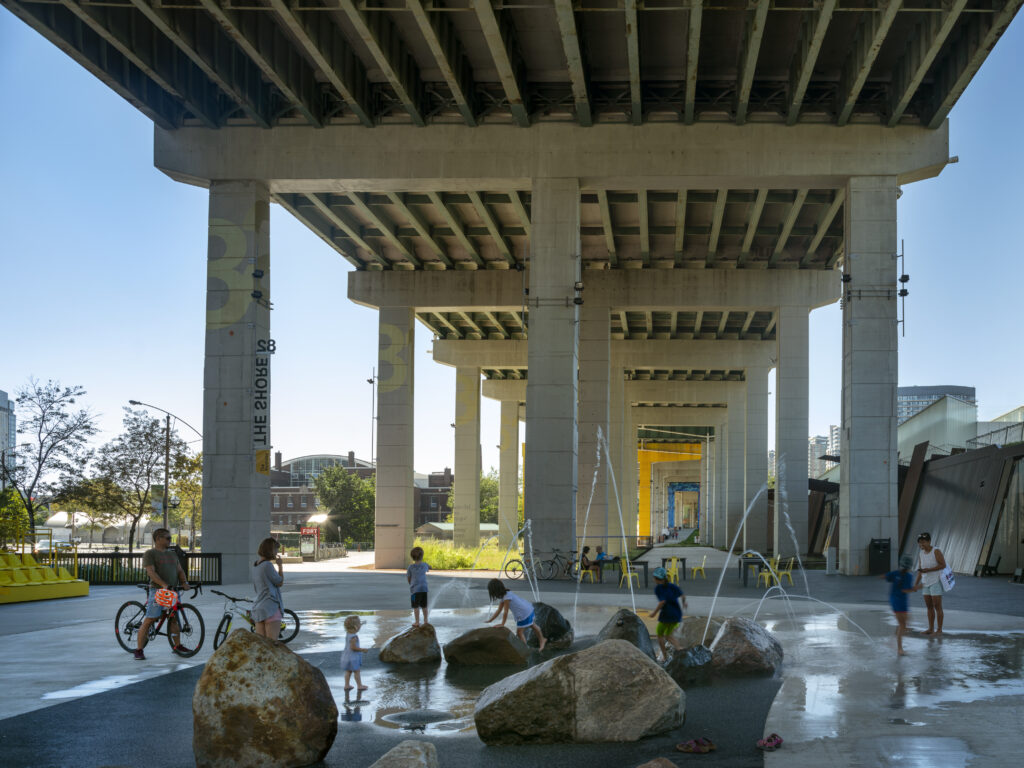
The Bentway itself, just to the south, offers a natural extension. A former underpass reimagined as civic infrastructure, The Bentway connects CityPlace to the waterfront and frames a shared language of adaptation. Where Canoe Landing is open and green, The Bentway is shaded and architectural. Together, they define a growing network of public life across reclaimed land.
Grounding a High-Rise Community
CityPlace still reads as a newer neighborhood, though it has become more defined. Canoe Landing Park has helped turn a collection of towers into something more legible: a place with rhythms, rituals, and shared civic ground.
As new projects rise around it and a southerly park expansion moves toward a 2026 completion, Canoe Landing remains a blueprint. Not just a park, but a necessary anchor. A reminder that even in the densest parts of the city, community starts at street level.
Discover more third places in Toronto like Stackt Market and the Ace Hotel Lobby.