Digital Orca


Digital Orca
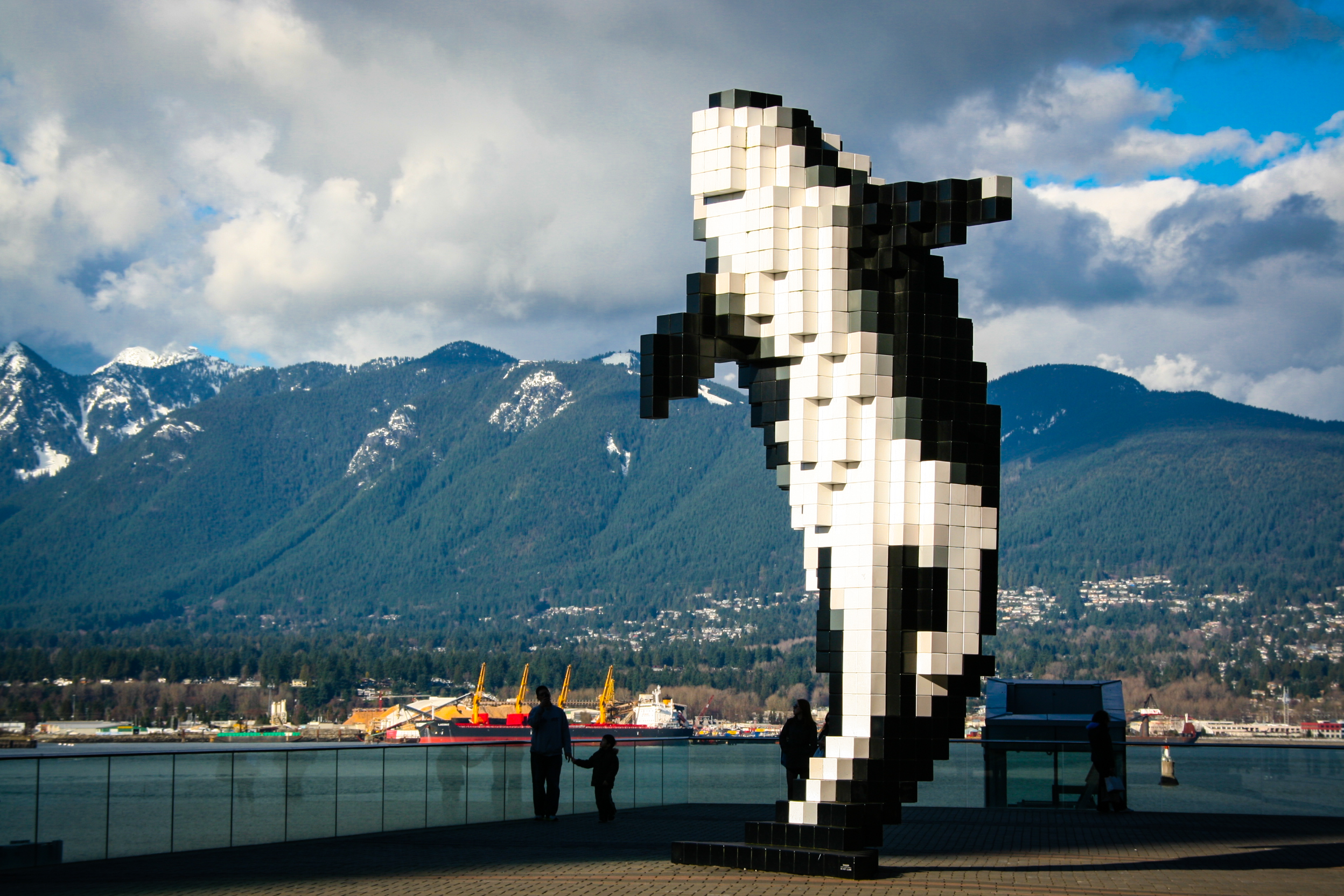
On the edge of Vancouver’s Jack Poole Plaza, adjacent to the Vancouver Convention Centre and framed by a sweeping view of Coal Harbour, a whale breaches—not in fluid arcs of muscle and skin, but as a towering sculpture built of cubic pixels. This is Digital Orca, a work by renowned Canadian artist and author Douglas Coupland, unveiled in 2009 as a public art commission for the City of Vancouver.
Coupland’s sculpture renders a killer whale, a familiar and sacred symbol of the Pacific Northwest, not in naturalistic curves, but in stark black and white cubes. It appears as though plucked from a digital simulation or 1980s video game and dropped, mid-leap, into the heart of a modern city. Constructed from powder-coated aluminum and supported by a stainless steel armature, the orca’s form feels frozen in motion. From a distance, it reads as sleek and solid; up close, it becomes a pointillist explosion of geometry.
Digital Orca isn’t simply a stylized tribute to marine life, it’s a deliberate collision of worlds: nature and code, biology and bitmap. For Coupland, the orca functions as a “bridge between the past and the future,” linking the maritime legacy of Vancouver’s working harbour to the city’s evolving digital economy. At night, embedded LEDs flicker subtly across its structure, evoking both marine bioluminescence and the constant hum of circuitry, a quiet nod to the modern workplace inside the adjacent convention centre.
The sculpture is also a prime example of Coupland’s larger body of work, which interrogates the effects of technology, globalization, and modern identity. Born in 1961 in West Germany and raised in West Vancouver, Douglas Coupland achieved international fame as the author of Generation X: Tales for an Accelerated Culture (1991), a novel that gave voice to the disaffection and ambivalence of a generation caught between analog upbringing and digital adulthood. Over the decades, he has written more than a dozen novels, along with works of non-fiction, television scripts, and visual art.
Since returning to visual practice in the early 2000s, Coupland has become one of Canada’s most prominent contemporary artists. His public art includes pieces such as Golden Tree, a monumental, gold-painted cast of the iconic Stanley Park Hollow Tree, and Infinite Tires, a spiraling tower made entirely of stacked automotive tires. Like Digital Orca, these works are playful but pointed, blending pop aesthetics with social commentary.
Digital Orca’s location is just as meaningful as its form. Facing the harbor, it is a literal and symbolic interface between land and sea, technology and tradition. The orca is a powerful creature in the mythology of the Coast Salish peoples, long viewed as an emblem of strength, protection, and kinship. By reimagining it in digital form, Coupland neither diminishes its symbolism nor makes it cartoonish—instead, he updates the visual vocabulary, creating space for reflection in a city where glass towers and data streams increasingly define the horizon.
The sculpture has become a beloved icon of downtown Vancouver. Tourists pose with it. Children play beneath its overhang. Locals pass it daily, sometimes pausing to admire its uncanny stillness. And though it seems solid, even monolithic, Digital Orca is also a temporal object—one whose meaning continues to evolve alongside the very technologies that inspired it.
In a city grappling with the push-pull of progress and preservation, Coupland’s pixelated whale makes a quiet yet profound statement: that even in a digitized world, the symbols that root us to place and memory can still rise, majestic, from the sea.